Essay · First version under review
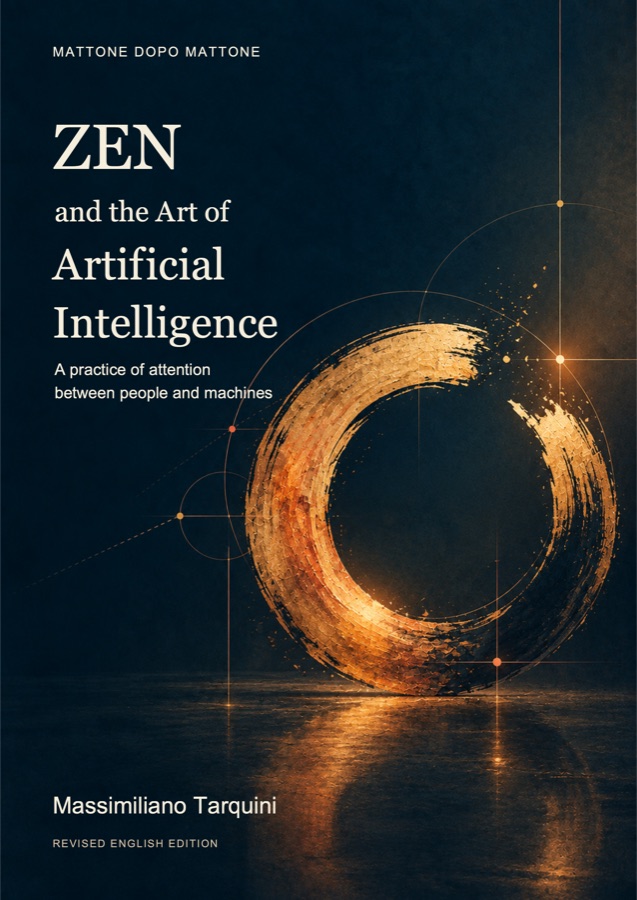
ZEN and the Art of Artificial Intelligence
A practice of attention between people and machines
This essay explores the boundary between language, artificial intelligence and attention: an invitation to observe our relationship with machines and preserve our own judgement.
Explore the contents ↓The next step: reading.
First revised English edition · 122 pages. Author and teaching review remains open.
PDF · 6.1 MB · English
Download the book ↓Distribution licence to be defined.
THE READING JOURNEY
Table of contents
The essay moves through five parts, from encountering artificial intelligence to the practice of attention and design decisions. The titles follow the contents of the first revised English edition.
Before you begin
The introduction and prologue open the essay’s journey.
- Introduction Working with attention
- Prologue At the edge of silicon
Part I Before believing the machine
- Chapter 1 What we call artificial intelligence
- Chapter 2 How a model learns
- Chapter 3 When language becomes an interface
Part II Between capabilities and illusions
- Chapter 4 The capabilities that emerge
- Chapter 5 Plausible answers facts and hallucinations
- Chapter 6 The world in the data bias and representation
Part III AI in the fabric of life
- Chapter 7 A mirror of culture
- Chapter 8 Small everyday acts of delegation
- Chapter 9 Small is beautiful intelligence close to people
Part IV The practice of attention
- Chapter 10 Pausing before asking
- Chapter 11 Reading an answer without clinging to it
- Chapter 12 Collaborating while retaining your judgement
Part V Designing with presence
- Chapter 13 Human-centred artificial intelligence
- Chapter 14 From intention to design choices
- Chapter 15 Teaching and learning to live with AI
Epilogue and reading resources
- Epilogue Code as a kōan
- Appendix A A glossary to explore
- Appendix B Questions and annotated practices
- Appendix C Reading and references
- Appendix D List of figures
- The author
BEFORE YOU START
A question to start with.
How can we work with a machine without handing over our judgement?
The book builds the tools to address this question and recognise the limits of the answers.