After building the loop of an assistant working with a person, the project opened a different question: what does a small agent need to pursue something of her own? Little Velia, also called Baby Velia, starts here. Her design provides interests, projects and an autonomous loop distinct from adult Velia’s.
The first progress is in design. The current revision identifies the technical foundation to reuse and contracts for persistent identity, the autonomous loop, permissions and first creations. These contracts describe how the software should work; the Baby loop still needs implementing. Exploring them helps explain why she is taking this shape.
Before personality, a place for her history
The proposed memory separates episodes, interests, goals, personality, mood and projects. An episode describes an event that happened; an interest identifies something to pursue; mood concerns the current state. Separating them allows a change of mind without rewriting the past. Deleting a dialogue must also avoid accidentally deleting her identity and all her projects.
A loop that can also choose to wait
In the proposed loop, events arrive: a message, an activity’s outcome or a chosen time to reconsider a project. The model receives the event and relevant memory and decides how to proceed. She can create, seek advice, return to a task or wait. A timer signals that a decision is due; it does not determine her action or mood.
The host application preserves events and decisions, checks revisions and permissions and handles Stop. The intended autonomy operates within tools and sources actually granted. Adult Velia can be a mentor, while the little one keeps her identity: a suggestion from her mother remains an attributed suggestion.
Giving creativity something that can be reopened
The first creative capabilities have been defined around two-dimensional scenes, drawings and choice-based stories. Structured formats describe objects, graphic elements or narrative passages and links. They prepare the ground for saving creations, reopening them and checking their references. A format does not yet prove the autonomous loop can complete these operations.
Why add a Monte Carlo engine
Imagine a story with a door, a key and two endings. Writing a continuation is one option; comparing possible developments may reveal a missing clue or an unreachable ending. Monte Carlo names a family of methods that explore possibilities through sampling. In this project, the engine will support the model as an optional capability.
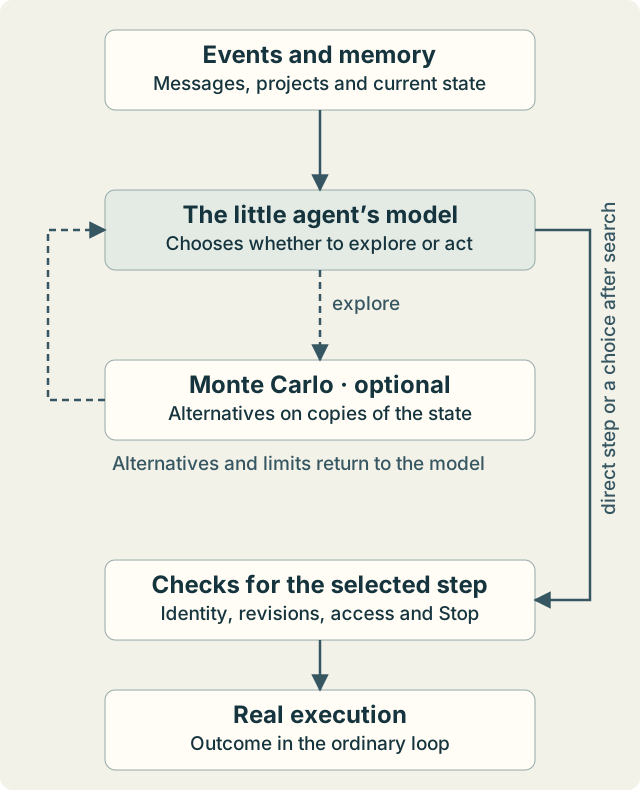
She will be able to choose whether to use the search, continue it, stop it or proceed directly. The engine will receive structured initial state, alternatives and criteria. It will return explored possibilities, evaluation limits and actual resource use. It will not choose interests, mood or permissions on the model’s behalf.
An imagined ending is not a game someone played
In the door example, a simulation can check on a copy of the state whether the key makes an ending reachable. It cannot establish that a person will enjoy the clue. Likewise, a human reaction imagined by the model does not become a received message. Simulation, evaluation and actual experience must keep distinct origins.
Explored branches will not publish content, send mail or change personal files to see what happens. When the model chooses a possibility to realise, the step will return to the ordinary executor with current permissions and revisions checked. Any model calls made during search still consume real time and resources.
The next step is showing whether it helps
The planned comparison places single generation, independent alternatives and MCTS side by side. Quality, time and resource use need comparing, including at comparable resources: more exploration may simply cost more. Today the integration is designed, not implemented or qualified; there is no demonstrated improvement to attribute to it yet.
The next chapter will return to the first brick: preserving identity and projects through a restart. Entries will follow actual development steps. The journal can then show how an idea takes shape, is tested and changes direction when necessary.