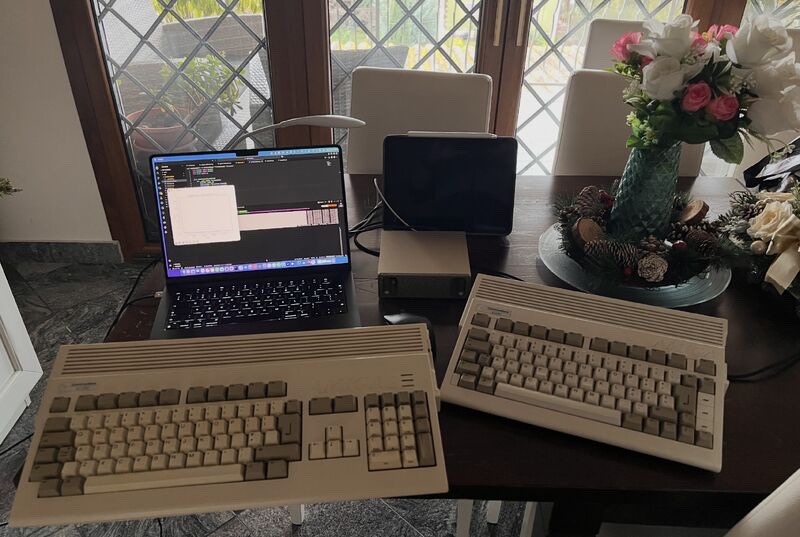
In front of me today, different eras coexist: keyboards that speak of a past made of limited memory and unlimited creativity, and modern systems for working with models that learn and generalize. In between, there is me. And the same ritual as always: turning on a machine and wondering what we might do together.
I still remember the excitement of my first Commodore 64. Then came the Amiga 600 and 1200, machines that profoundly shaped me and, in many ways, helped define who I am. They were promises of discovery, of control, of possibility. Every power-on was a small act of trust in the future, even when that future had to fit within a few kilobytes.
I have carried these machines with me over the years, giving back something of what they gave me by keeping them alive, functional, present. Judging by the table, the past still drops by now and then. And it takes up quite a bit of space.
Every time, in those moments, it feels like being a child again. It is that rare mental state where everything is still possible, where complexity invites you to try and curiosity speaks louder than the fear of making mistakes. A familiar keyboard is enough to bring that feeling back.
Today, the context has changed radically. We work with GPUs, neural models and distributed inference. The scale of the problems and the impact of the technologies have grown. And yet, the feeling is surprisingly similar: that invisible threshold between what already exists and what is still waiting to be explored.
The abstraction layers have multiplied. Back then, I dealt with memory and the constraints of the machine; today, I also work with behaviours, probabilities and results that require new forms of verification. The intent remains the same: to understand the system well enough to make something meaningful with it.
Receiving and bringing a machine like NVIDIA DGX Spark online becomes a point of continuity. Between those keyboards and today’s systems lie decades of hardware evolution and professional growth. The thread connecting them is still curiosity: the desire to understand, to try and to push a little further.
The machines change, the numbers grow and the table gets bigger. The question, in the end, is still the same: “What if we tried…?”